
What Credit Utilization Means for Your Score
How the share of credit you use affects lender decisions and your credit profile.
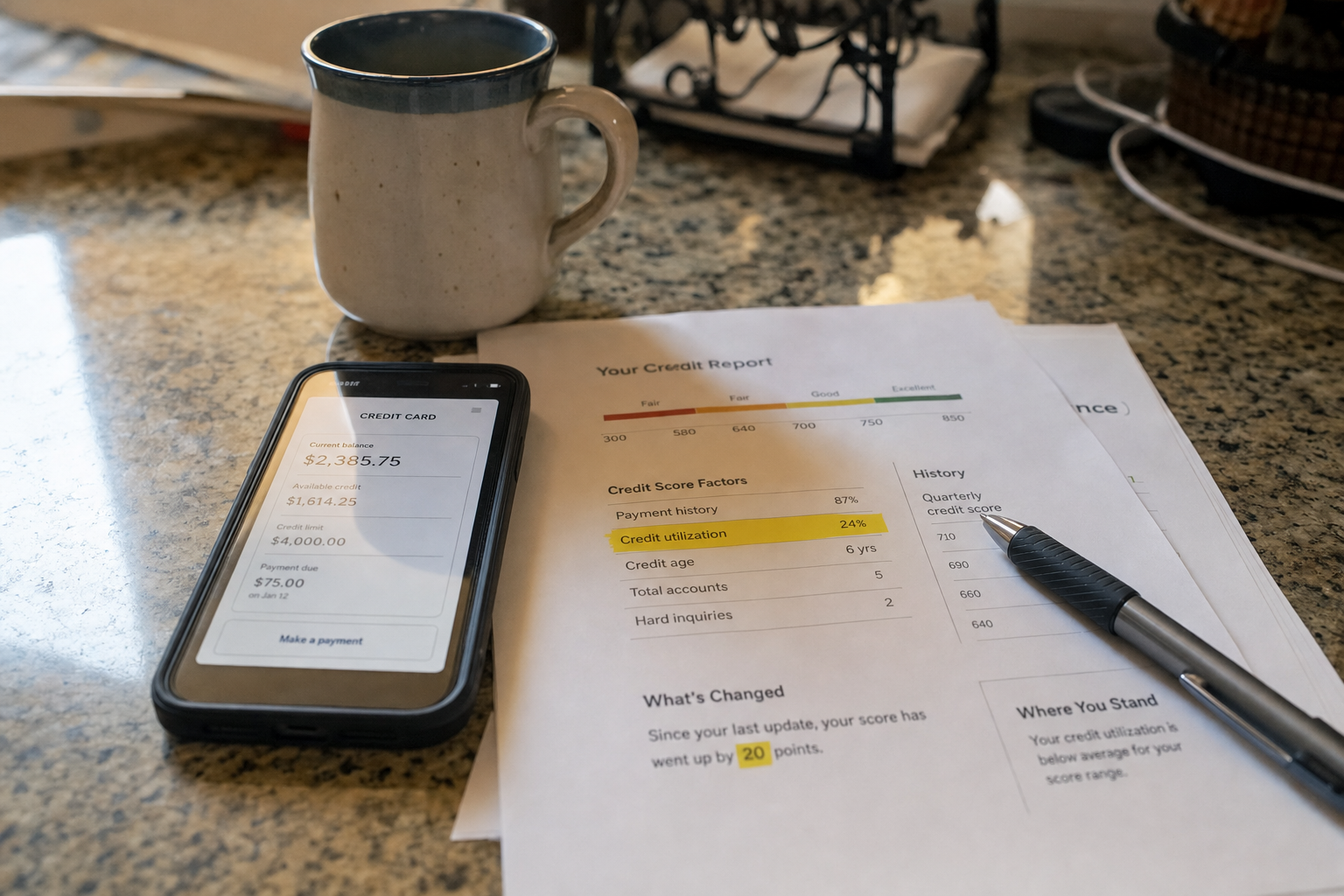
You check your credit-card statement and see a balance close to your limit.
You’ve been making every payment on time, but your credit score hasn’t moved the way you expected.
The missing piece may be credit utilization—the percentage of your available revolving credit that you’re currently using.
Lenders and scoring models treat this ratio as a signal of financial stress.
A high percentage can suggest you’re stretched thin, even if you never miss a payment.
A lower percentage generally tells lenders you have room to manage additional credit.
Understanding how credit utilization is calculated, why it matters, and what you can do about it gives you a concrete way to influence your credit profile without waiting for time to pass or old information to age off your report.
High utilization signals risk; lower utilization supports a stronger score.
Scoring models weigh the amount you owe on revolving accounts as a major factor, and keeping that percentage low generally works in your favor when lenders review your credit.
What Credit Utilization Measures
Credit utilization compares the balances on your revolving accounts with the total credit available on those accounts.
Revolving credit includes credit cards and certain lines of credit—accounts where you can borrow, repay, and borrow again up to a limit.
The formula for overall utilization is straightforward: divide your total revolving balances by your total revolving credit limits, then multiply by one hundred.
You can also calculate utilization on each card individually by dividing that card’s balance by its limit.
If you carry balances on multiple cards, both your overall ratio and the utilization on individual cards can matter.
In FICO scoring models, both aggregate and per-card utilization are reviewed separately.
A single card that’s nearly maxed out may affect your FICO score even if your aggregate utilization is low.
Installment loans such as mortgages and car loans have fixed payment schedules and are not included in the revolving-credit utilization calculation.
Why Lenders and Scoring Models Care
Amounts owed—including credit utilization—are a major category in FICO credit-scoring models.
The exact weight varies by your complete credit profile, but the category is commonly described as a significant portion of your FICO score.
A high utilization ratio can suggest you’re relying heavily on credit to cover expenses.
Lenders may interpret that as a sign of greater risk, because it can indicate less financial cushion if an unexpected expense arises.
Lower utilization generally signals that you’re managing credit comfortably and not stretching your available limits.
It doesn’t guarantee approval or a specific score, but it removes one potential red flag from your credit report.
Scoring models differ in how they treat utilization.
FICO and VantageScore use different formulas and weightings, so the effect on your score can vary depending on which model a lender uses and your overall credit profile.
| Scenario | Balance | Limit | Utilization |
|---|---|---|---|
| Card A | $800 | $2,000 | 40% |
| Card B | $300 | $5,000 | 6% |
| Combined | $1,100 | $7,000 | 15.7% |
The Guideline You’ve Heard—and What It Really Means
You’ve probably seen advice to keep your credit utilization low.
In general, the lower your utilization, the better, as long as you’re using credit responsibly.
There is no universal cutoff that applies across all scoring models and lender decisions.
Scoring models weigh many factors together—payment history, account age, new credit, and credit mix all play a role.
The guideline reflects the observation that lower utilization tends to be associated with stronger credit profiles in FICO and other models.
In FICO scoring, per-card utilization also counts.
Even if your overall ratio is low, a single card that’s close to its limit can still affect your FICO score.
Practical Steps to Lower Your Ratio
The most direct way to lower your utilization is to pay down your revolving balances.
Reducing what you owe lowers the numerator in the utilization formula.
Another option is to increase your total available credit.
You can request a credit-limit increase on an existing card or open a new card.
Both actions may involve a lender review and can have separate effects on your credit profile, so consider your ability to manage additional credit responsibly.
If you decide to request a higher limit, make sure you won’t be tempted to increase your spending.
A higher limit only helps your utilization if your balance stays the same or goes down.
Timing matters.
Card issuers generally report balances to the credit bureaus near the end of your billing cycle or statement period, though practices can differ by issuer.
Making a payment before your issuer reports can reduce the balance that appears on your credit report.
Questions That Come Up
Does carrying a balance improve your score?
No evidence supports the idea that paying interest improves your credit.
Utilization can be reported even if you pay your full statement balance by the due date.
Is zero percent utilization bad?
The effect of zero utilization can vary by scoring model and the rest of your credit file.
Some models may treat zero balances differently, and the impact depends on your complete credit profile.
Does utilization apply to car loans or mortgages?
The revolving-credit utilization calculation focuses on credit cards and similar revolving accounts.
Fixed installment loans are not included in that calculation.
Will lowering utilization permanently fix my score?
Utilization is generally a current-balance factor, so the effect may change when newly reported balances change.
Other negative information, such as late payments, is separate and has its own timeline.
Understanding credit utilization gives you a concrete tool for managing your credit profile.
Lower utilization generally works in your favor, but it’s only one piece of a larger picture that includes payment history, account age, and the types of credit you use.
Check your credit report regularly to see how your balances and limits are being reported.
If you notice your ratio climbing higher than you’d like, adjust your payment strategy or consider requesting a limit increase if you can manage the additional credit responsibly.
* Credit reporting practices and scoring models can change. Confirm current details with your card issuer and check your credit report through AnnualCreditReport.com. For general consumer guidance, visit the Consumer Financial Protection Bureau. For information on FICO scoring factors, see myFICO.