
How to Build a Car Maintenance Budget Using Your Own Vehicle Data
Plan a yearly reserve from your manual, mileage, and repair history—not a national average.
You just got an estimate for new brakes, and your checking account balance says no.
Or your car is due for a service interval you didn’t see coming, and you’re weighing whether to delay it another month.
These moments reveal the gap between what you thought car ownership would cost and what it actually demands.
A car maintenance budget closes that gap.
It turns irregular expenses into predictable monthly savings, so routine service and unexpected repairs don’t compete with groceries or rent.
The challenge is finding the right number.
National averages exist, but your reserve depends on your vehicle’s age, current mileage, maintenance schedule, and recent repair history.
This guide walks through a method to calculate a yearly reserve, split it into monthly savings, and adjust it as your car ages.
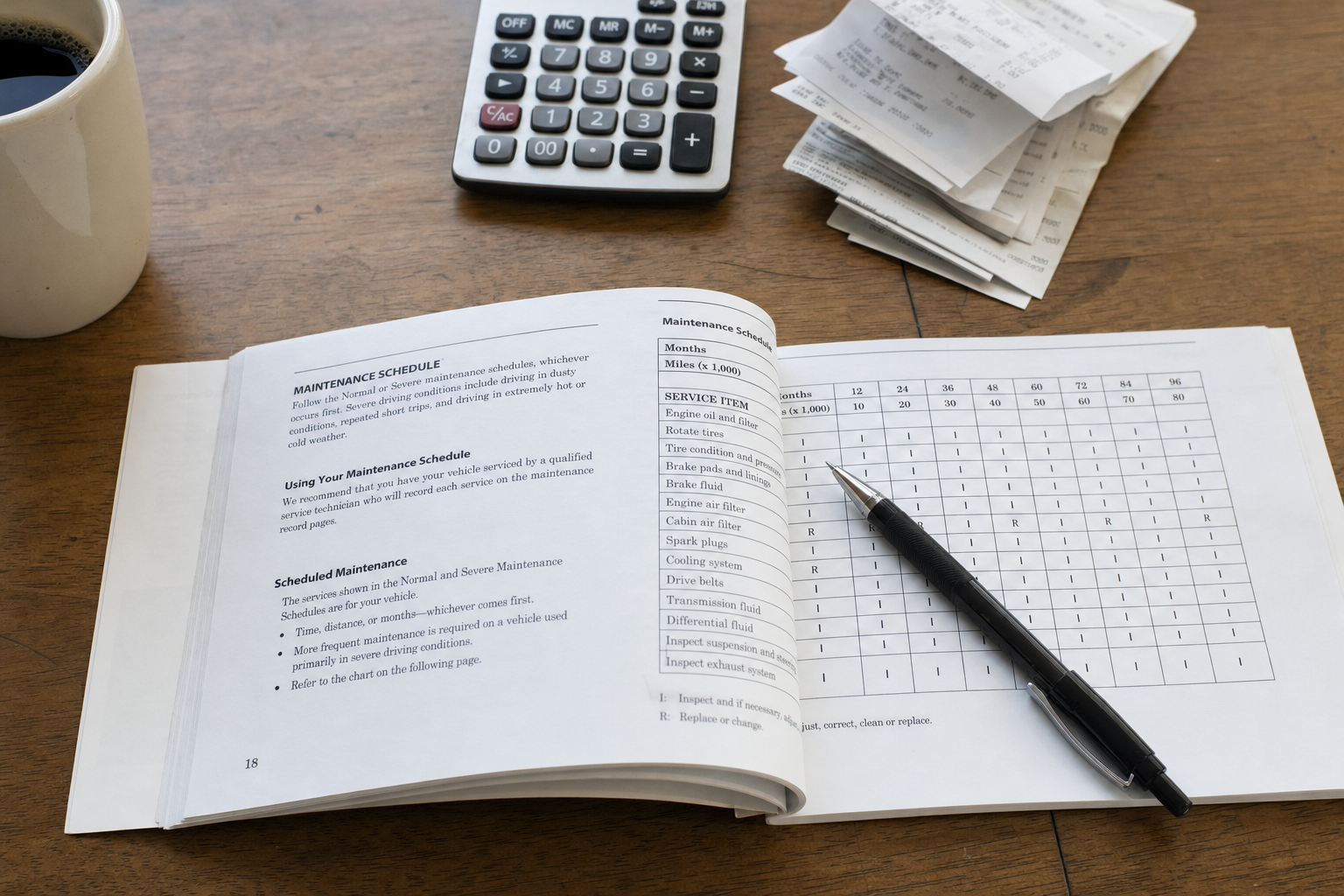
Your owner’s manual is the starting point, not a generic estimate.
The most accurate car maintenance budget is built from your vehicle’s actual service schedule, expected wear items over the next twelve months, and a separate cushion for repairs you can’t predict.
Start with your vehicle’s maintenance schedule
Open your owner’s manual or download it from the manufacturer’s website.
Look for the maintenance schedule section.
List every service due in the next twelve months based on your current odometer reading and the date of your last oil change, filter replacement, or fluid service.
Many manufacturer schedules show intervals by both mileage and time, whichever comes first.
Check your specific owner’s manual to confirm which format applies to your vehicle.
If you drive ten thousand miles a year, you’ll cross certain mileage thresholds; if you drive less, time-based intervals may arrive first.
Write down each upcoming service: oil and filter, cabin air filter, engine air filter, tire rotation, brake inspection, coolant flush, transmission fluid, differential service, spark plugs.
Not every item will be due this year, but the manual tells you which ones are.
Add wear items and a repair cushion
Scheduled maintenance is predictable.
Wear items and unexpected failures are not, but you can estimate them.
Check your tire tread depth.
If your tires are halfway through their life, budget for replacement within the next year or two.
If your battery is showing slow cranking or visible signs of age, plan for a new one.
Look at your brake pads and rotors.
If the pads are thin or you hear grinding, replacement is imminent.
If they’re fine now, estimate when they’ll need attention based on your driving style and mileage.
Include wiper blades, belts, and hoses if they’re cracked or aged.
These are small expenses individually, but they add up.
Set aside a separate amount for repairs you can’t predict: a failed alternator, a leaking hose, a sensor that stops working.
This contingency keeps routine spending from draining your emergency fund.
Calculate your monthly reserve
Add the cost of scheduled services due in the next twelve months.
Add the estimated cost of wear items you expect to replace.
Add your contingency for unexpected repairs.
Divide the total by twelve.
That’s your monthly savings target.
If you don’t have recent repair receipts, use your manual and current quotes from local shops to estimate each service.
If you do have a year or two of receipts, calculate an annual average and adjust it for your vehicle’s current age and mileage.
The formula is simple: (scheduled maintenance + wear items + contingency) ÷ 12 = monthly reserve.
| Component | How to estimate |
|---|---|
| Scheduled service | List services due in next 12 months from owner’s manual |
| Wear items | Estimate tires, brakes, battery based on age and condition |
| Contingency | Review past receipts or set aside a fixed buffer |
| Monthly reserve | Annual total ÷ 12 |
Set up a dedicated account and automate transfers
Open a separate savings account or label a portion of your main savings as your car fund.
Keeping the money separate reduces the temptation to spend it on other things.
Set up an automatic transfer on payday.
Treat the monthly reserve like rent or a utility bill: it leaves your checking account before you allocate money to discretionary spending.
When you pay for service or a repair, withdraw from the fund and keep the receipt.
Track the date, service, and amount in a spreadsheet or note app so you can compare actual spending to your budget.
If you don’t use the full reserve during the year, leave the balance in the account.
Maintenance costs are rarely uniform: one year may be light, the next may bring a major service interval or an expensive component failure.
Adjust as your vehicle ages and mileage climbs
At the end of each year, compare your actual spending to your budget.
If you consistently underspend, you can reduce the monthly reserve or let the surplus build.
If you overspend, increase the monthly amount or investigate whether deferred maintenance is catching up.
Vehicles with higher mileage often need a larger reserve.
Wear accelerates, and parts that were reliable for years begin to fail more often.
Watch for major service intervals.
Requirements and intervals for timing-belt replacement, transmission-fluid changes, and coolant-system overhauls vary widely by make, model, and engine type.
Check your specific owner’s manual and budget extra in the year those services arrive if they’re scheduled for your vehicle.
Driving conditions also matter.
Each manufacturer defines severe service differently, using criteria such as frequent short trips, stop-and-go traffic, extreme temperatures, dusty conditions, towing, or prolonged idling.
Consult your owner’s manual or your automaker’s official website for the exact criteria and adjusted intervals that apply to your vehicle.
If you switch vehicles, recalculate from scratch.
A newer car will have lower maintenance needs; an older or different make may require a completely different reserve.
A car maintenance budget isn’t static.
It evolves with your vehicle, your driving habits, and the repairs that actually occur.
The goal is readiness, not perfection.
By planning a yearly reserve, splitting it into monthly savings, and adjusting as you go, you turn unpredictable car costs into a manageable part of your household budget.
The result is less financial stress, more control over when and where you get service, and the confidence that you’re ready when your mechanic calls.
* Maintenance costs vary by vehicle, location, and service provider. Consult your owner’s manual and review current pricing with local shops for the most accurate estimate. AAA Driving Costs study and calculator