
What Lenders Actually Evaluate in Your Car Loan Application
Approval depends on credit, income, debt, down payment, and the vehicle—not one factor alone.
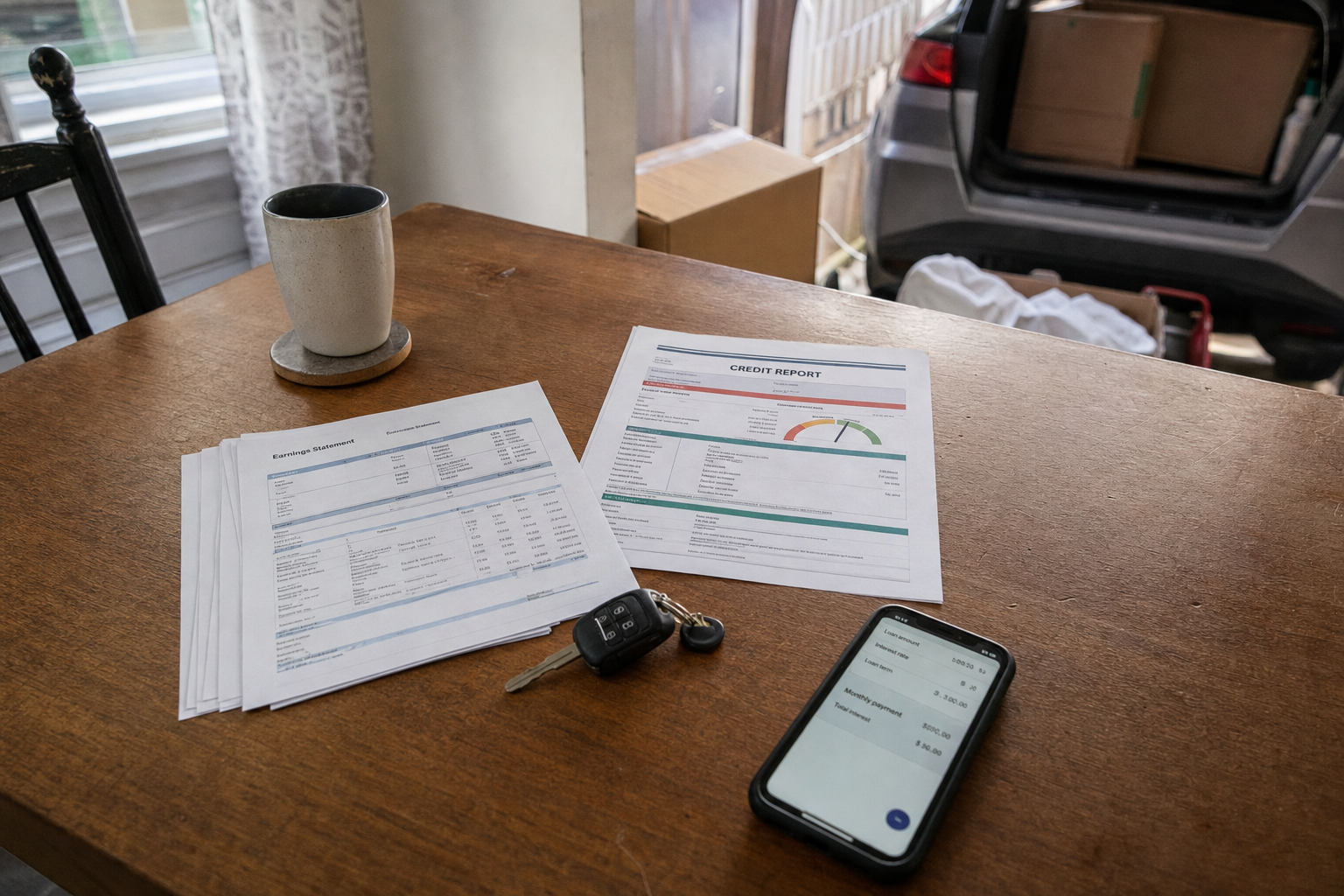
You found the car you want, and the dealer handed you a finance worksheet with a monthly payment estimate.
Now you’re wondering whether you’ll be approved—and at what rate.
Lenders don’t make that decision based on a single number.
They look at your credit file, your income, your existing debts, the amount you’re putting down, and the vehicle itself.
Each piece tells part of the story, and no single weakness automatically disqualifies you.
Understanding car loan approval factors before you apply helps you prepare the right documents, set realistic expectations, and spot which parts of your application you can strengthen right now.
Lenders evaluate the full picture, not a checklist.
A strong credit score can offset a higher debt load; a large down payment can compensate for thinner credit history. Requirements vary by institution, so a denial at one lender doesn’t mean you won’t qualify elsewhere.
Your credit file tells a story beyond the score
When you submit an application, the lender pulls your credit report and reviews your score.
That score is a snapshot of risk, but the lender also reads the details: how long you’ve had credit, whether you’ve paid on time, how much of your available credit you’re using, and whether you’ve recently applied for other loans.
There is no universal minimum score that every lender requires.
Some institutions work with borrowers who have limited or damaged credit; others set stricter thresholds.
A higher score generally improves your chances of approval and access to better terms, while a lower score may lead to higher costs or require additional documentation.
Income and job history show capacity to pay
Lenders need to see that you earn enough to cover the proposed monthly payment along with your other obligations.
You’ll typically be asked to provide recent pay stubs, tax returns, or bank statements that confirm your income.
Employment information is part of the application.
Lenders may review how long you’ve been in your current job or industry as an indicator of income stability.
The specific weight given to job tenure varies by lender and underwriting policy.
If you’re self-employed or earn variable income—commissions, freelance payments, seasonal work—check with your lender about what documentation they require.
Self-employed applicants often need to provide additional records to verify consistent earnings over time.
Debt-to-income ratio measures breathing room
Your debt-to-income ratio compares your recurring monthly debt payments—credit cards, student loans, mortgages, other car loans—to your gross monthly income.
Lenders use DTI to judge whether adding a car payment will leave you with enough income to meet all your obligations comfortably.
Each lender sets its own acceptable DTI range.
A lower DTI generally strengthens your application because it signals more financial margin.
If your DTI is high, consider paying down existing debt before applying or choosing a less expensive vehicle to reduce the monthly payment.
Down payment and trade-in change the math
A down payment reduces the amount you need to finance.
The loan-to-value ratio compares the amount financed to the vehicle’s actual cash value, and lenders use LTV as part of their lending decision.
A larger down payment lowers the LTV, which can improve your approval odds and may qualify you for better terms.
If you’re trading in a vehicle, the lender will consider the value of that trade-in and any remaining loan balance you owe on it.
The net equity—trade-in value minus payoff—can serve as part of your down payment.
If you owe more than the trade-in is worth, that difference will be added to the amount you need to finance, raising the LTV.
Down payment and trade-in equity don’t automatically compensate for every credit or affordability issue, but they do reduce the lender’s risk and the size of your monthly commitment.
If you can wait a few months to save more or pay down your existing car loan, the stronger LTV may open more financing options.
The vehicle you choose affects the lender’s risk
The car you want to buy serves as collateral for the loan, so lenders evaluate factors related to the vehicle’s value.
They consider the type of vehicle, its age, mileage, condition, and estimated market value.
These characteristics may affect how much the lender is willing to finance and at what terms.
Some lenders have broader vehicle eligibility guidelines; others focus on specific categories, model ranges, or mileage limits.
The vehicle’s appraised value affects the LTV calculation: if the purchase price is higher than the actual cash value, the LTV will be higher, which lenders consider in their decision.
| Vehicle category | Typical lender considerations |
|---|---|
| New or certified pre-owned | Lower collateral risk; broader lender acceptance |
| Used, recent model | Moderate risk; most lenders finance |
| Older or high-mileage | Higher risk; some lenders impose age or mileage caps |
Loan amount and term shape the monthly commitment
The amount you want to borrow and the repayment term you choose are both car loan approval factors in the lender’s decision.
A longer term spreads payments over more months, lowering the monthly amount but increasing total interest.
A shorter term raises the monthly payment but reduces total cost.
Lenders evaluate whether the resulting monthly payment fits within your income and DTI.
If the payment is too high relative to your income, the lender may counter with a smaller loan amount, a longer term, or a request for a larger down payment.
Choosing a realistic loan structure before you apply can improve your approval chances and help you avoid stretching your budget.
Documentation requirements vary by lender
Lenders will ask for documents to verify information about your identity, income, employment, debts, and the vehicle you want to finance.
Requirements vary by institution, but commonly requested items may include a government-issued ID, recent income documentation, proof of insurance, and vehicle details or trade-in information.
Having your documents ready before you apply can speed up the process and demonstrate that you’re a prepared borrower.
If you’re missing a document or unsure what a lender needs, ask before submitting your application.
Self-employed applicants and those with non-traditional income should confirm documentation requirements early.
- Government-issued photo ID (driver’s license or passport)
- Proof of income (pay stubs, tax returns, bank statements)
- Proof of residence (utility bill, lease agreement)
- Vehicle information (VIN, purchase agreement, trade-in payoff)
- Proof of insurance or ability to obtain coverage
Lenders evaluate car loan approval factors as a package, not in isolation.
A weakness in one area—credit score, DTI, down payment—may be offset by strength in another.
No single factor guarantees approval or denial, and requirements vary by institution.
Before you apply, check your credit report for errors, calculate your DTI, and gather income documentation.
Compare offers from banks, credit unions, and other lenders to see which institution’s underwriting criteria fit your profile.
The Consumer Financial Protection Bureau’s auto-loan guide offers additional steps for shopping and comparing financing sources.
* Lender requirements and underwriting criteria change over time and vary by institution. Verify current policies and documentation needs with your lender or visit consumerfinance.gov for general auto-loan guidance.