
Lease vs Buy Car: Comparing What You Really Pay
Monthly payment alone won't tell you which option costs less over time.
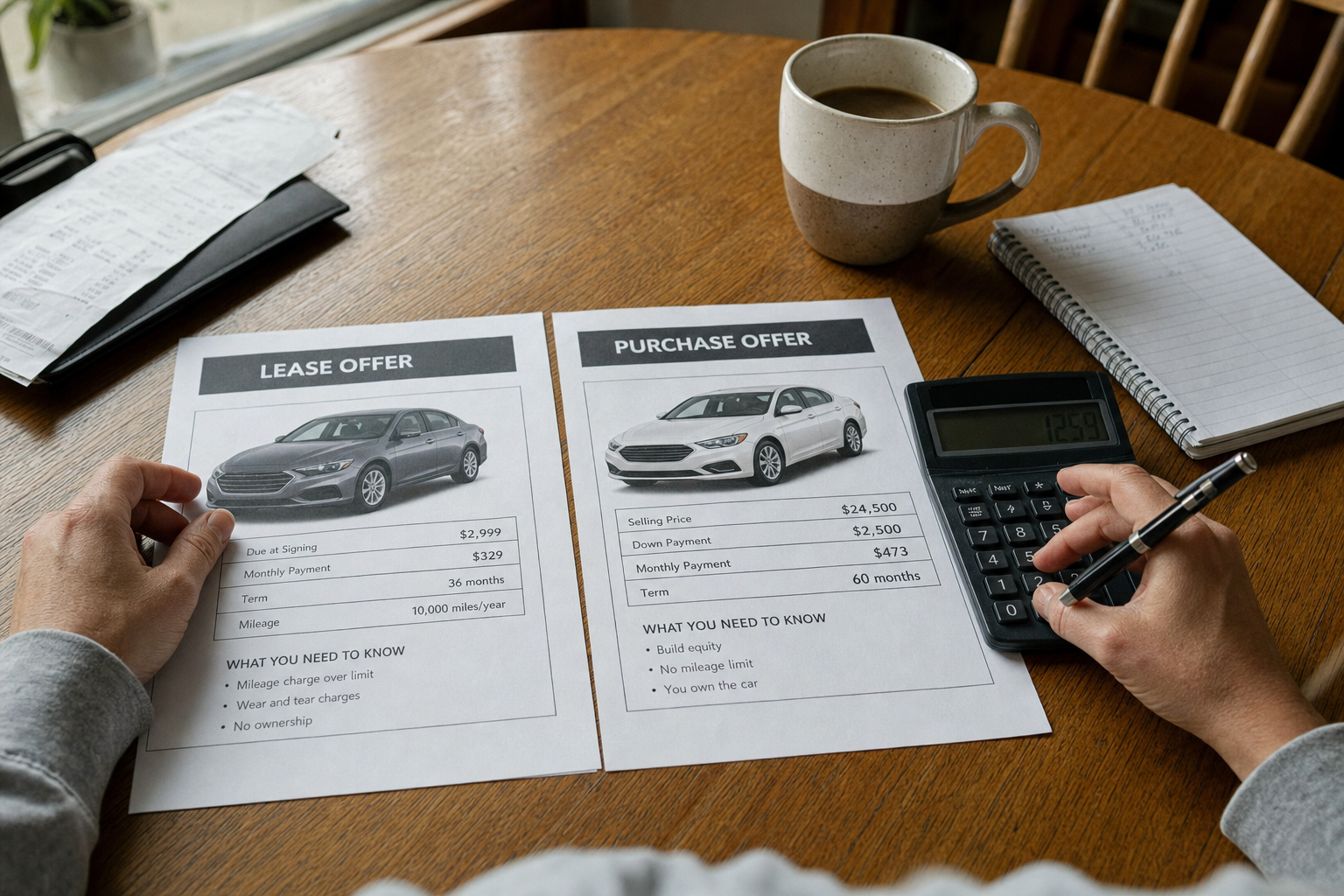
You’re at the dealership with two offers in front of you.
One shows a lease payment that fits your budget easily. The other is a purchase loan with a higher monthly number.
The salesperson says the lease is the better deal because the payment is lower.
That comparison leaves out most of the money you’ll actually spend.
Deciding between lease vs buy car requires adding up everything you pay over the same period and then subtracting what you have at the end.
A lease generally covers the vehicle’s depreciation during the term, plus rent charges, taxes, and fees. A purchase loan covers the vehicle’s full price, plus interest.
Lease payments reflect depreciation and rent charges rather than ownership principal, while purchase payments pay down the vehicle’s full cost.
The monthly payment is not the total cost.
To compare fairly, add every dollar you’ll pay—upfront, monthly, and at the end—then subtract the value you keep. That difference is what each option actually costs you.
What you’re paying for in a lease
When you lease, your payments primarily cover the vehicle’s expected drop in value during the lease term.
The lessor calculates that depreciation, adds a rent charge, and includes taxes and fees. You’re paying to use the vehicle, not to own it.
Your lease contract will list every charge that may apply: acquisition fee, security deposit, first payment, registration, and any capitalized-cost reduction you agree to.
At the end of the term, you return the vehicle unless the contract includes a purchase option and you choose to exercise it.
Lease contracts commonly impose mileage limits and may charge for excess mileage, excessive wear, or early termination.
What you’re paying for when you buy
A financed purchase means you’re paying the vehicle’s full price, spread over the loan term, plus interest and finance charges.
You also pay taxes, registration, title, and any dealer or lender fees upfront or rolled into the loan.
The lender holds a lien on the vehicle until the loan is paid in full.
You can keep driving it without a payment, sell it, or trade it in once the lien is released. Any remaining vehicle value belongs to you.
Building the full cost picture for each option
Start with everything due at signing.
For a lease, that may include the first payment, acquisition fee, security deposit, taxes, registration, and any down payment or capitalized-cost reduction.
For a purchase, it typically includes your down payment, taxes, registration, title, and dealer fees.
Next, add all scheduled payments over the comparison period.
Consider including insurance, maintenance, and repairs in both scenarios. For a lease, add expected mileage or wear charges if your contract specifies them.
For a purchase, include routine service and any repairs you expect to pay.
At the end of the comparison period, adjust for what you have.
If you leased, you normally return the vehicle and have nothing unless you exercise a purchase option.
If you bought, subtract the vehicle’s market or trade-in value from your total cash paid. If a loan balance remains, subtract that balance from the vehicle’s value to find your net equity.
| Cost element | Lease | Purchase |
|---|---|---|
| Upfront | First payment, fees, deposit, taxes | Down payment, taxes, title, fees |
| Monthly | Depreciation, rent charge, taxes | Principal, interest |
| End of term | Return vehicle, pay any contract charges | Keep or sell vehicle |
| Equity | None unless you buy at lease end | Vehicle value minus remaining loan |
The value you keep at the end
A lease normally ends with vehicle return.
You walk away with no ownership stake unless your contract includes a purchase option and you pay the specified residual amount, plus any fees and taxes.
A purchase ends with full ownership once the loan is paid and the lien is released.
The vehicle’s remaining value is yours.
Buying may offer ongoing use without a payment after the loan is satisfied, while the lease customer must start a new contract or buy another vehicle.
When the numbers may favor one path over the other
Leasing may fit your situation if you drive within the contract mileage limit, return the vehicle in good condition, and the lease includes strong manufacturer incentives.
It may also work if you want a new vehicle regularly and prefer predictable payments without ownership responsibility.
Buying can reduce your total cost if you keep the vehicle after the loan is paid off, because you continue using it without a payment.
If you plan to drive the vehicle for many years, modify it, or want to build equity, purchasing is often the stronger financial choice.
The result depends on the complete contract economics, not the payment alone.
Use the same vehicle, the same time horizon, realistic mileage and maintenance assumptions, and current market values to compare total cash paid minus what you have at the end.
Questions to answer before you commit
- How many years do you plan to keep the vehicle?
- How many miles will you drive each year, and does the lease contract allow that mileage?
- What is the total cash you’ll pay for each option over the same period, minus what you have at the end?
- What charges will you owe at lease end, and are they included in your comparison?
- Do you want to own the vehicle and build equity, or do you prefer returning it and starting fresh?
Run the numbers for both options using the same vehicle and the same comparison period.
Include every upfront charge, every monthly payment, insurance, maintenance, and any end-of-term charges or credits. Subtract the value you keep at the end.
The option with the lower net cost after accounting for what you have is the one that saves you money.
Review your lease agreement and purchase contract carefully, and confirm current terms with the lessor or lender before you sign.
* Contract terms, fees, and vehicle values change frequently. Confirm current offers and review official guidance at consumer.ftc.gov.